Industrial power and controls
Industrial electrical for plant floors, distribution centers and process lines
Switchgear, power distribution, conveyor automation and electrical demolition, built to the same standard whether the job is one panel or a whole facility.
Chapter 01
Fifty years combined, still run out of Muskogee
Moore Electric & Logistics is a new company name over an old set of hands. Between the crew there is more than fifty years of combined electrical experience, and Dennis Moore himself has put in thirty-two of those years. That history is why the company can say, without much fanfare, that it applies the latest methods to improve service, raise productivity and hold down cost on work that used to take longer and cost more.
None of that scale shows up in the size of the office. This is a small shop, and the way it stays competitive against bigger contractors is by taking on projects that people normally assume only a large company could handle, then actually delivering them. The crew stays on the project they are assigned to, start to finish, rather than getting spread across five jobs at once.
That is a deliberate choice, not a limitation the company works around. A larger outfit spreads its best people across more projects than any one of them can really absorb attention from. Moore keeps the roster small enough that the same hands who bid a job are usually the ones who close it out.
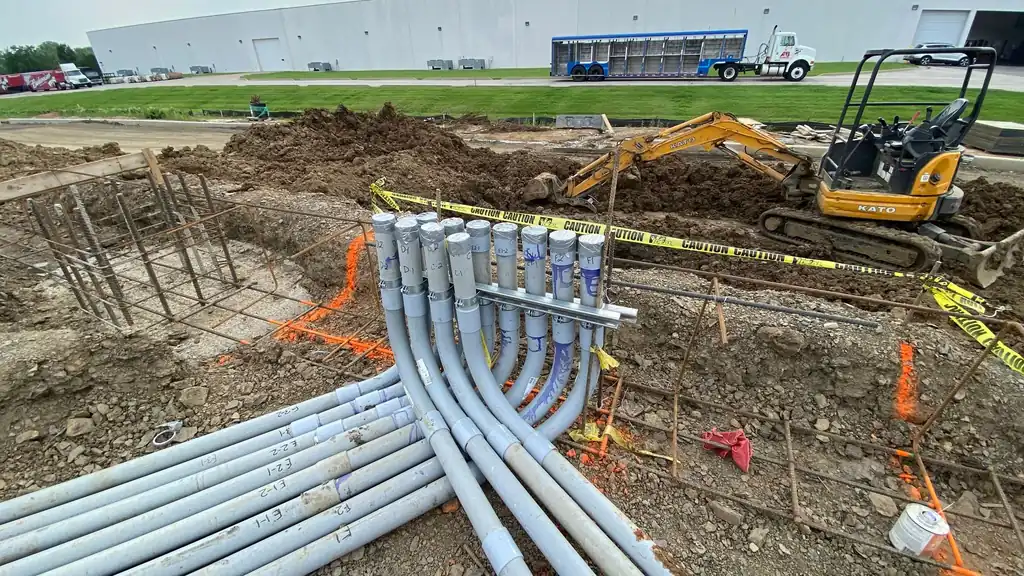
Labeled duct bank sweeping out of a trench into a strut rack in front of a distribution building
The scope: switchgear to conveyor automation
The industrial side of the business covers switchgear installation, power distribution, lighting, power and low-voltage wiring, and the full range of electrical controls. On a plant floor that usually means conveyor automation and conveyor controls, access control at doors and gates, and the electrical demolition that has to happen before any of the new work goes in.
Every one of those systems gets installed to the National Electric Code plus whatever the project specification and the local code call for on top of it. Moore's people have managed or installed electrical power and control systems across the country, not just in eastern Oklahoma, which is part of why a project engineer can hand over drawings without having to walk the crew through code basics first.
Lighting and low-voltage work rarely stand alone on an industrial site. A high bay retrofit usually rides alongside a controls upgrade or a new conveyor run, and treating them as one coordinated scope instead of three separate trade calls is where a lot of the schedule gets saved.
Chapter 03
One point of contact, from bid to punch list
The stated method is short and it has not changed since 2007: a single point of contact for each project, technical experience that has actually been tested on a job site, and cost effectiveness that shows up in the invoice, not just the sales pitch. Dependability means the project finishes on time. Reliability means the objectives and the schedule get hit the first time, not the third.
Behind that is a team approach and strict adherence to detailed processes and schedules, which sounds like boilerplate until a plant is trying to hit a shutdown window or a general contractor is trying to close out a job. Proficient logistics management of personnel, materials and financial resources is what keeps a multi-week industrial job from sliding.
Bids that hold, and a network for the rest
Accuracy in bidding is treated as its own discipline here, specifically because it eliminates unnecessary change orders and keeps the program cost held in check once the work starts. A bid that is wrong on scope turns into a change order later, and a change order later is what actually blows a project budget, not the original number.
For the parts of a project that fall outside electrical work, Moore has built a network of companies that deliver the ancillary trades a job needs. The goal is a single phone call that covers the whole scope, so a client gets the confidence of one relationship managing a project instead of chasing separate contractors for every trade that touches it.
What the license number backs up
Moore Electric & Logistics holds Oklahoma electrical contractor license 38459, and is both DBE certified and TERO certified. The company has been a BBB accredited business since September of 2012, and is a member of the Eastern Oklahoma Chapter of the National Electrical Contractors Association.
None of that is decoration. On industrial and public-sector work, a DBE or TERO requirement can be the difference between a contractor qualifying for a bid list and not, and a license number is the first thing a plant engineer or a project manager checks before handing over drawings. It is there to be checked.
The Eastern Oklahoma Chapter membership and the BBB record since 2012 do a quieter version of the same job over a longer stretch of time. A license proves the company is allowed to do the work. More than a decade on the same BBB record and an active NECA membership are what show it has kept doing it, project after project, without the name changing hands.
Moore Electric, Oklahoma license 38459. DBE and TERO certified. BBB accredited since 2012. Member, Eastern Oklahoma Chapter NECA. Call (918) 686-5509.