What a Duct Bank Actually Costs You If It Goes In Wrong
Once concrete goes over a duct bank, every mistake underneath it becomes a demolition problem instead of a punch-list item.
September 4, 2026 · 4 min read
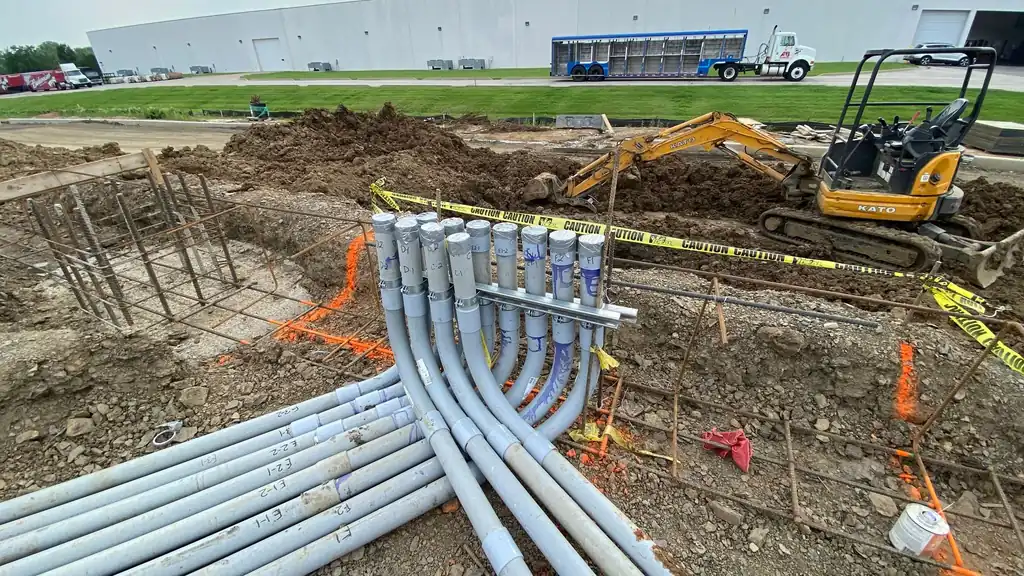
A duct bank looks simple once it's covered. Rigid or PVC conduit in a trench, spaced correctly, wrapped in concrete or backfill, capped with warning tape. The work that decides whether it stays simple happens before any of that goes in the ground, and once the pour sets, the window to fix a mistake closes for good. That's the part of the job an owner or a general contractor's project manager never sees, and it's the part that decides whether the electrical scope stays on schedule or turns into the reason the whole site slips.
The moment the concrete goes down, the job changes
Before the pour, a wrong conduit run is a five-minute fix. Move it, re-sweep it, recheck the spacing. After the pour, the same mistake means saw-cutting or breaking out a slab that was never supposed to be touched again, tracing a buried run by guesswork, and stopping whatever else is happening on that site while it gets sorted out. On a live distribution facility or a downtown build like Depot Green Muskogee, that delay doesn't stay contained to the electrical scope. It holds up paving, landscaping, whoever else is scheduled to close that ground next. The cost of a duct bank mistake is never just the conduit. It's every trade behind it that was counting on the ground being closed on schedule.
What site conditions actually decide
No two duct banks sit in the same ground. A trench cut on a downtown lot with existing utilities nearby is a different exercise than one cut across open acreage next to a new distribution facility, and the excavation equipment, the number of parallel ways, and the sequence of the pour all follow from that. Reading the site correctly before the trench opens, not adjusting on the fly once it does, is what keeps the schedule from slipping into the next trade's window.
Label every run before the pour, not after
Every run in a duct bank needs to be identified before it disappears under concrete: what it carries, where it starts, where it ends. That labeling has to happen while the trench is still open and every conduit is still visible side by side, because once backfill or concrete goes over the top, there's no second chance to check which run is which. A duct bank with six or eight parallel ways and no clear record of what's in each one turns a future tie-in or repair into exploratory digging.
Sweeps, bend radius, and why spare ways matter
A conduit run that changes direction needs a sweep with enough radius to pull cable through it without damaging the jacket, not a tight elbow that looks fine on paper and fights every pull afterward. It's worth building in a spare way or two beyond what the current load needs. A distribution center or a growing plant floor rarely stays at its original electrical load, and an empty spare conduit already in the ground costs a fraction of what it costs to open the same trench again in a few years to add one.
Depth and warning tape are not optional extras
Duct bank depth has to account for what's going to sit on top of it, whether that's foot traffic, a forklift aisle, or heavy equipment crossing the yard, and warning tape goes in above the run so the next crew that opens that ground, whoever they are, sees it before their excavator does. Skipping either one doesn't show up as a problem on install day. It shows up months or years later, when somebody else is digging on the same site with no idea what's underneath them.
A downtown stub-up and a distribution center are not the same duct bank
The duct bank work behind Depot Green Muskogee, with stub-ups set into a fresh slab on a downtown lot, calls for a different plan than the runs feeding a large distribution facility with a crane rail and dock doors down one wall. Site conditions, the number of ways, and what else is scheduled to happen on that ground all change the layout. Treating every duct bank the same way is how spare capacity gets left out and labeling gets skipped.
- Every run identified and recorded while it's still visible in the open trench
- Sweeps and bend radius sized for the cable that has to pull through later, not just what fits today
- At least one spare way where future load growth is likely
- Depth set for what will sit on top of the ground once it's closed
- Warning tape placed above the run for the next crew that digs there
Moore Electric & Logistics, (918) 686-5509
Call (918) 686-5509More articles
Reading a Switchgear Submittal Before It Becomes a Change Order
The line between a revised drawing and a change order is whether the switchgear submittal actually got read before the bid went out.
Why Lighting Retrofits Get Quoted Twice
The first lighting retrofit quote is a fixture count. The one that holds is built after somebody actually checks what's feeding those fixtures.