Why Lighting Retrofits Get Quoted Twice
The first lighting retrofit quote is a fixture count. The one that holds is built after somebody actually checks what's feeding those fixtures.
September 4, 2026 · 3 min read
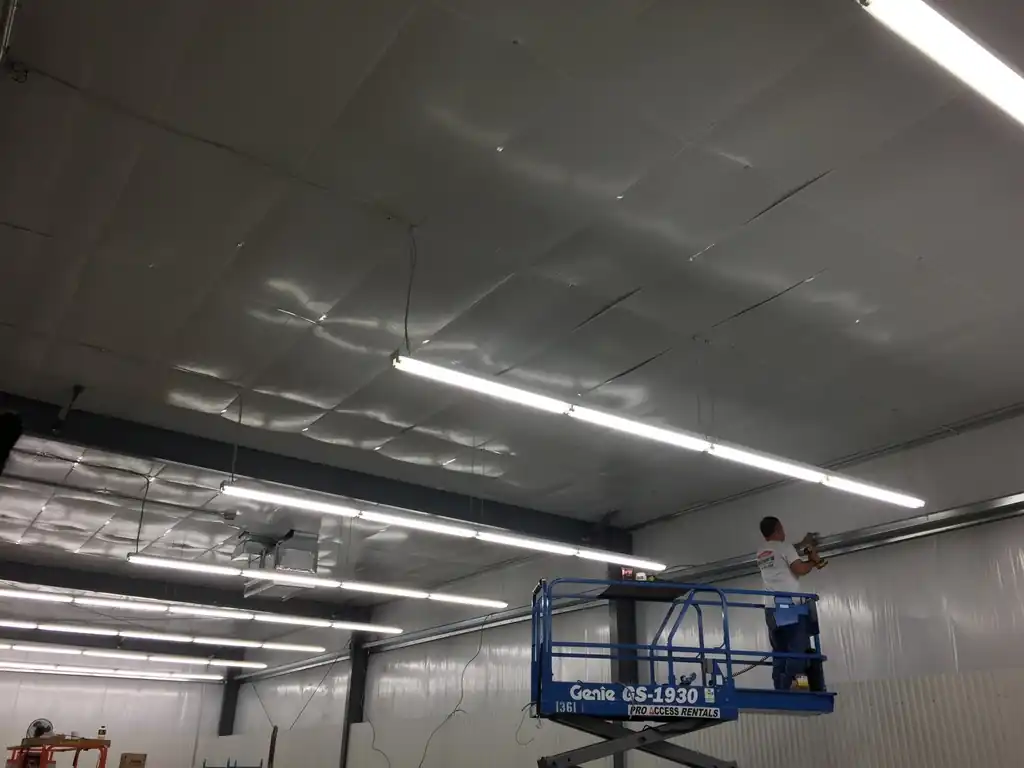
A high-bay lighting retrofit quote can look identical to the one before it until somebody gets a lift up to the existing fixtures and finds out what's actually feeding them. That's usually where the first number turns into a second one, and it's why a fast quote and an accurate quote are rarely the same document.
The first walk-through only tells you so much
From the floor, a warehouse or high-bay lighting job looks like a fixture count. Replace this many high-bays, replace this many strip lights, done. What the floor walk doesn't show is the condition of the circuits already running to those fixtures, what panel they're on, or whether that panel has room to take a different load profile than the one it was built for. A walk-through is a starting point for the conversation, not the number a general contractor's project manager should be building a budget around.
Existing circuit capacity decides more than the fixture count
New high-bay fixtures, especially LED retrofits, often draw differently than what's been running for years. Before a quote can hold, somebody needs to confirm the existing circuits and panel can carry the new load, or work out what it takes to get them there. That's not visible from a fixture count. It only shows up once the existing wiring and panel schedule get checked against what's actually being installed. On a distribution center or a warehouse running high-bay LEDs and HVLS fans off the same panels, that check matters even more, because there's less spare capacity to absorb a miscalculation.
What a scissor lift actually reveals
Getting an electrician on a Genie scissor lift up to the fixture level, rather than estimating from photos or from the floor, is what turns an assumption into a fact. That's where a loose junction, an undersized conductor, or a circuit already carrying more than it should gets found, before it becomes a surprise mid-install. Skipping that step to save a day on the front end is how a fixed-price quote turns into a change order once the lift finally goes up.
Controls and occupancy sensing change the scope, not just the price
A straight fixture swap and a fixture swap with occupancy sensing and zoned controls are two different jobs, even if the light fixtures themselves are identical. Controls mean additional wiring, additional devices, and a commissioning step to confirm the sensors and zones work the way the building actually operates, not just the way they were specified. Leaving controls out of the first quote and adding them once the fixtures are already up is exactly how a project ends up quoted twice.
Working at height on a building that's still running
High-bay work happens on a scissor lift, well above the floor, in a building that in most cases is still operating. That means coordinating lift access around forklift traffic, staging around whatever's stored under the fixtures being replaced, and doing electrical demolition and installation without shutting the whole facility down. None of that shows up in a fixture count either, and all of it affects how long the job actually takes.
Why the second quote is usually the real one
The first quote, built on a fixture count and a floor walk, is a starting point. The second one, built after checking circuit capacity, confirming controls scope, and planning lift access around the building's actual operating hours, is the one that holds once the job starts. Getting to that second number earlier, before the fixtures are ordered, is what keeps a lighting retrofit on budget instead of turning into a mid-project renegotiation.
None of this means the first number was dishonest. It means a fixture count alone was never enough information to price the job on. A warehouse or distribution center running high-bay lighting, HVLS fans, and dock equipment off the same electrical service has more variables than a fixture list can capture, and the quote that accounts for those variables up front is the one worth signing.
- Existing circuit and panel capacity checked against the new fixture load
- Controls and occupancy sensing scoped in from the start, not added later
- A lift access plan that accounts for what's stored or operating underneath
- A schedule that works around the building's actual operating hours
- Confirmation of what circuits the new fixtures will actually run on
Moore Electric & Logistics, (918) 686-5509
Call (918) 686-5509More articles
What a Duct Bank Actually Costs You If It Goes In Wrong
Once concrete goes over a duct bank, every mistake underneath it becomes a demolition problem instead of a punch-list item.
Reading a Switchgear Submittal Before It Becomes a Change Order
The line between a revised drawing and a change order is whether the switchgear submittal actually got read before the bid went out.