Electrical Work on Water Infrastructure: What Makes a Spillway Different From a Building
Gate hoist power and conduit racking under a bridge deck follow a different set of rules than anything inside four walls.
September 4, 2026 · 3 min read
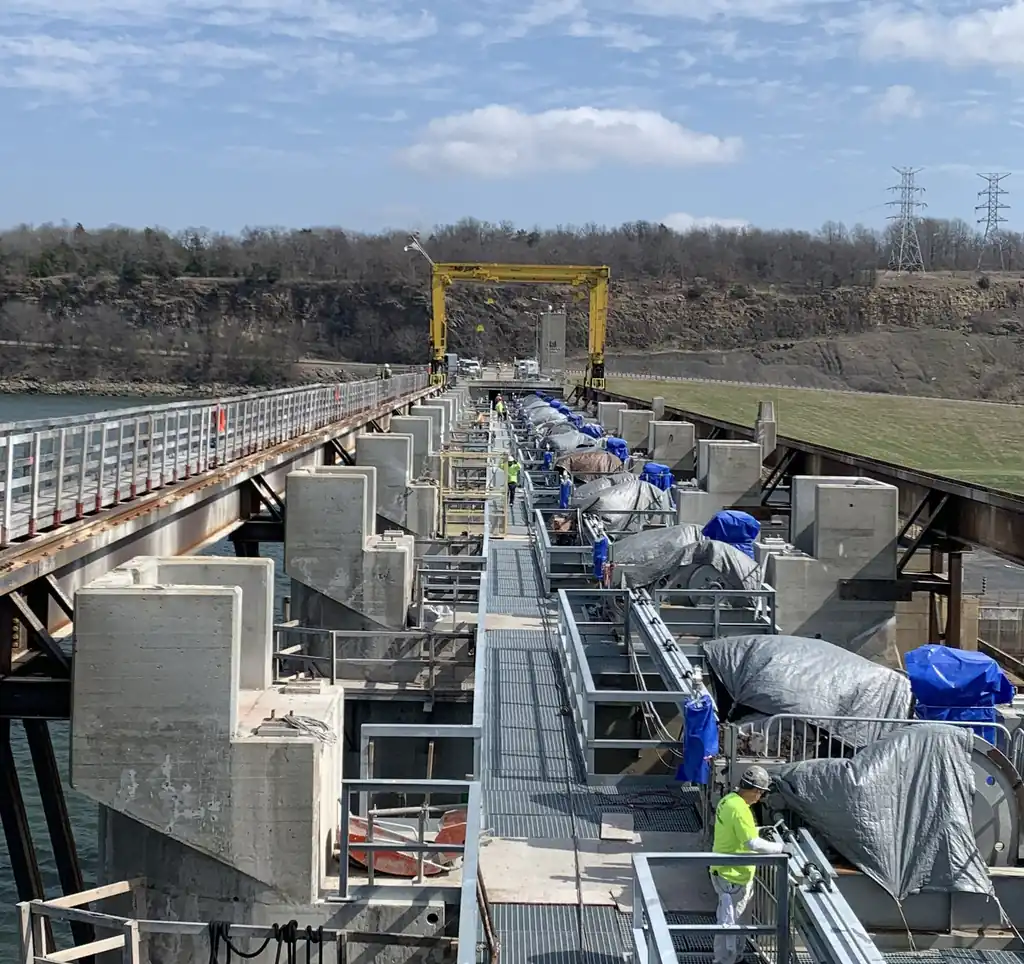
Wiring a building and wiring a dam spillway both end with power getting where it needs to go, but almost nothing else about the two jobs is the same. The Eufaula spillway work, gate hoist power and conduit racking under the bridge deck, is a useful example of what changes when the site is water infrastructure instead of a building, and why a contractor's commercial and industrial background doesn't automatically transfer to it.
Corrosion and moisture change every material decision
A building enclosure keeps most of the weather off the wiring inside it. A spillway deck doesn't. Conduit racked under a bridge deck over a lake spillway sits exposed to moisture, spray, and temperature swings in a way conduit inside four walls never does. Material choices, from the conduit itself to the racking and hardware holding it, have to account for a corrosion environment that a typical commercial job never has to think about. A fitting that would last decades inside a warehouse can start failing years early out over open water, and there's no ceiling to open later to catch it before it becomes a problem.
Rigid conduit and racking under a deck
Running conduit under a bridge deck means racking it to a structure that wasn't built with electrical runs in mind, in a space with limited access and a lake underneath. Every fitting and every support has to be secured to hold up under its own weight, wind, and vibration from the structure above it, in a location where checking on it later means going back out over the water rather than opening a ceiling. Staging that conduit, whether it's bundled runs banked under the walkway or stock staged on the deck itself, has to happen without blocking the access the civil crew needs to keep working the same structure.
Gate hoist power is not a standard load
The electrical load on a spillway includes the power feeding the gate hoists, the equipment that actually raises and lowers the spillway gates. That's a different kind of load than lighting or general power distribution, tied to equipment whose operation matters for flood control, not just building operations. Getting that circuit right isn't optional the way a dimmed hallway light is optional.
Working over water and coordinating with the civil crew
Spillway work happens alongside a civil crew handling the structure itself, on a site where a chunk of the workday is spent staged on a deck with open water below it. Access, staging, and sequencing all have to be coordinated with whoever's running the civil side of the job, because the electrical scope can't get ahead of, or fall behind, the structural work it depends on.
Water treatment plants carry the same lesson
Water treatment plant electrical work carries a version of the same problem: corrosive or humid environments, equipment tied to processes that can't just be shut off casually, and a site built for water and chemical handling rather than for running conduit. Spillway upgrades and water treatment plant work both call for a contractor who has actually done this kind of site before, not one applying a standard commercial approach to a site that doesn't work like a commercial building.
Why this class of work needs the right contractor
None of this is exotic knowledge, but all of it has to be right the first time. A gate hoist that doesn't get power when the spillway needs it, or conduit racking that fails under a bridge deck a few years in, isn't a punch-list item. It's a piece of flood infrastructure. That's the case for hiring a contractor with a track record on water infrastructure specifically, not just commercial and industrial power distribution. The Eufaula spillway crews working in hi-vis along the deck, tarped gate hoists behind them, are doing electrical work that has to hold up the same way the concrete and steel around it does.
- Corrosion-resistant materials and hardware for a permanently exposed environment
- Conduit racking secured to structures not originally built for electrical runs
- Gate hoist and process loads tied to equipment that can't simply be shut off
- Coordination with the civil crew on access, staging, and sequencing
- Experience with the specific site type, not a generic commercial approach
Moore Electric & Logistics, (918) 686-5509
Call (918) 686-5509More articles
What a Duct Bank Actually Costs You If It Goes In Wrong
Once concrete goes over a duct bank, every mistake underneath it becomes a demolition problem instead of a punch-list item.
Reading a Switchgear Submittal Before It Becomes a Change Order
The line between a revised drawing and a change order is whether the switchgear submittal actually got read before the bid went out.